 Zeta
Zeta staking delegates ZETA to validators and currently requires a 21-day unbonding wait
Zeta staking delegates native ZETA to ZetaChain validators and currently requires a 21-day wait when unstaking. Delegations support consensus, with network rewards shared after validator commission. The wait begins when unstaking takes effect on the chain, not when the original stake begins. Anuma's Token Dashboard can recognize staking from bound external wallets for AI credits. Native staking continues while the approved Solana migration awaits a separate implementation proposal.
Updated on
Bonded ZETA determines native reward eligibility
Native reward eligibility requires delegation to a bonded validator in the active set; the amount delegated determines your share of its rewards. ZetaChain's staking system holds the tokens and records their association with the delegating address, whose wallet authorizes changes. ZetaHub displays available ZETA, staked ZETA, and claimable rewards separately. A validator outside the bonded set can receive delegations without earning the active set's block rewards. Spendable tokens held in a wallet do not create a delegation, so the available balance and earning stake have different roles.
Keplr also supports native delegation, while Anuma adds account-based AI-credit benefits to eligible ZetaChain staking.
Within Anuma, binding an external wallet connects its eligible staking balance to an account's AI-credit entitlement. Binding proves control with a message signature and does not move tokens. The Token Dashboard combines staking balances across linked wallets. Each underlying delegation remains associated with its own wallet address on ZetaChain.
Rewards reach delegators after validator commission
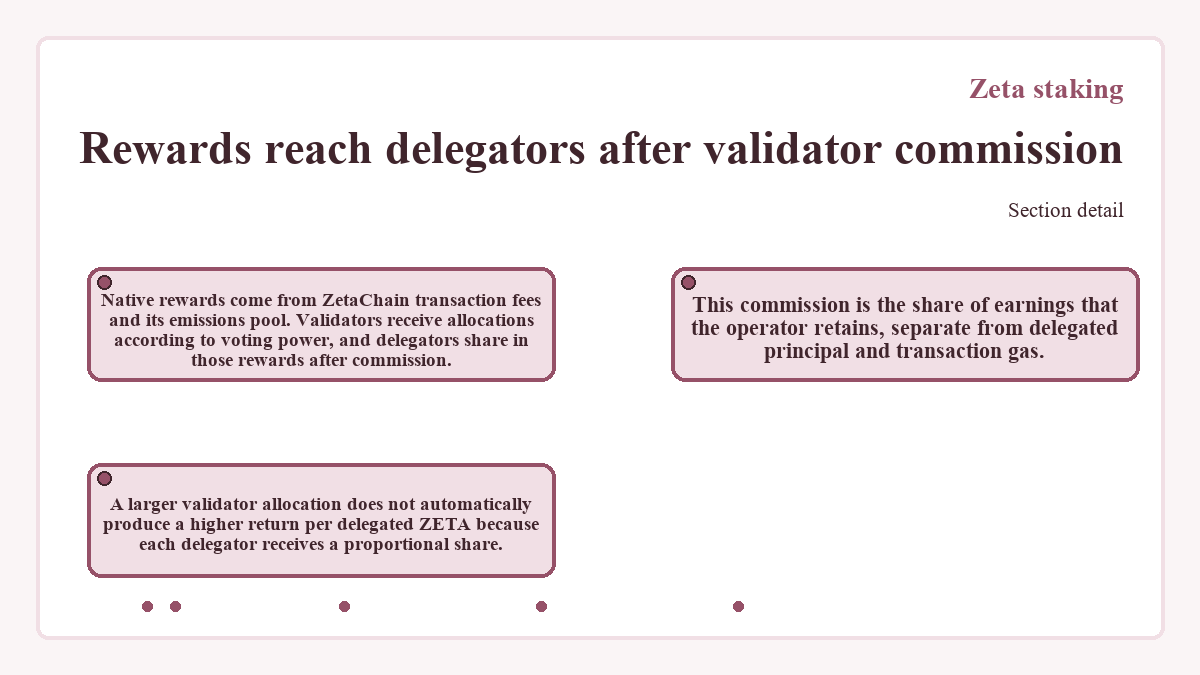
Native rewards come from ZetaChain transaction fees and its emissions pool. Validators receive allocations according to voting power, and delegators share in those rewards after commission. This commission is the share of earnings that the operator retains, separate from delegated principal and transaction gas. A larger validator allocation does not automatically produce a higher return per delegated ZETA because each delegator receives a proportional share.
A validator with a 100% commission rate retains all staking rewards that would otherwise go to its delegators. ZetaHub lists commission alongside status and uptime.
An annual percentage rate, or APR, expresses an annualized reward estimate. The distribution rate, total eligible stake, and validator commission influence that estimate, so it can change while the delegation remains the same size. A ZETA-denominated return also has a changing monetary value because the token's market price can move.
ZetaHub provides a claim action for accrued ZETA earnings, which remain separate from bonded principal. Anuma AI credits pay for app usage. Eligible bound stake earns credits without a minimum balance; staking-based Pro requires the combined balance to meet the threshold shown in the Token Dashboard. The Token Dashboard's calculator estimates both benefits using its live rates; the displayed estimate is separate from rewards already accrued.
Why must some ZETA remain available for gas?
Staking and unstaking spend ZETA as network gas, so the wallet needs liquid tokens outside its bonded position. This fee pays for processing the transaction and is separate from validator commission on rewards. Anuma wallet binding uses a message signature and costs no network gas. Tokens still inside an unbonding entry cannot fund a new transaction before their release.
When does the 21-day unstaking wait begin?
The wait begins when an undelegation takes effect on ZetaChain, creating an unbonding entry. The documented unbonding period for native ZETA staking on ZetaChain is currently 21 days. The original delegation date does not start this exit countdown, so a long-held stake still waits after leaving an active validator. The successful unstaking transaction establishes that the exit began; it does not establish that the waiting period has finished.
During unbonding, the selected ZETA stops earning native staking rewards and remains unavailable for ordinary spending. Anuma stops new AI-credit accrual on the portion that leaves staking, while the eligible remaining stake continues to count.
ZetaHub shows each entry's withdrawal date; its remaining balance becomes available to the delegating wallet once the chain processes completion.
An undelegation starts its own waiting period, regardless of validator status. Native staking distinguishes bonded, already-unbonding, and unbonded validators. For all three states, the completion time is the undelegation's execution time plus the configured unbonding period, currently 21 days.
Partial unstaking leaves the remaining balance bonded
Partial unstaking reduces the earning balance by the amount that leaves the delegation. In this hypothetical example, the starting stake is 1,746 ZETA and the unstaking amount is 416 ZETA. Assume an active validator, no slashing, and a separate liquid balance for transaction gas.
The remaining delegation is 1,330 ZETA: 1,746 minus 416. That amount stays eligible for native rewards while the validator remains bonded.
The 416 ZETA enters unbonding and stops earning native rewards. Under the 21-day configuration, it waits for the recorded completion time before becoming spendable. The wallet's balances therefore distinguish 1,330 ZETA still delegated from 416 ZETA awaiting release. Both figures describe principal; accrued rewards remain a separate balance.
For an active validator, the unstaked amount does not change the configured exit period. The remaining delegation's eventual earnings still depend on reward distribution and commission.
Can redelegation change validators without making ZETA liquid?
Redelegation moves an existing delegation to another validator while keeping the ZETA within staking. ZetaHub supports this action, and the destination validator appears after a successful transaction. Rewards then follow the destination validator's eligibility and commission.
Repeat moves have protocol restrictions. For the same delegator, an immature incoming redelegation can block another move out of its destination validator. The chain retains the redelegation record during this tracking period, so a successful switch can still restrict the next move. Slashing can reduce delegated principal when a validator commits a penalized offense, including qualifying downtime or double-signing. Unbonding and redelegation can retain liability for eligible offenses committed before those changes began. Penalty conditions and fractions follow chain parameters. Custody of the wallet keys does not eliminate this validator-related exposure.
Future ZETA staking terms await a Solana implementation proposal
The migration direction approved in September 2026 preserves balances, including staked positions and Anuma credits. Validators continue operating, and native staking continues on ZetaChain until the token migration completes. A second proposal must define the snapshot, transfer mechanism, and schedule, including how staking rewards transition. The current Token Dashboard uses ZetaChain staking; an Anuma account's Solana wallet is separate from the external wallet bound for staking. Approval does not move an existing delegation onto Solana or establish its future staking terms. Native delegation remains governed by ZetaChain's parameters until an implemented migration changes that arrangement.
Worth knowing
-
Does unlinking an Anuma wallet release its staked ZETA?
- Unlinking removes the wallet's association with Anuma without unstaking its ZETA. The delegation remains on ZetaChain and under the wallet's control. Releasing bonded principal requires an on-chain undelegation, with the applicable unbonding delay.
-
Are earlier ZetaChain delegations recognized when I bind their wallet to Anuma?
- Anuma can recognize an existing eligible staking balance after you bind the external wallet that controls it. Binding associates that wallet with your account; it does not require moving the principal into Anuma custody. The wallet must support the Token Dashboard connection, and the stake must be on ZetaChain.
-
Is the embedded Anuma wallet eligible for Token Dashboard staking?
- The embedded Anuma wallet cannot be bound for Token Dashboard staking. This integration requires an external wallet holding ZETA on ZetaChain, separate from the wallet created with the Anuma account.
-
Do unused staking credits carry into the next monthly grant?
- Unused Anuma staking credits expire instead of rolling into the next monthly grant. Each grant lasts about 30 days, with its expiry shown in the dashboards. Staying staked supports fresh grants without extending an earlier grant's validity.
-
Will unstaking cancel a paid Anuma Pro subscription?
- Unstaking does not cancel an existing paid Anuma Pro subscription. Its billing continues under the subscription arrangement. Staking-based Pro eligibility separately follows the required staked balance, so losing that eligibility does not end a paid plan. Already granted staking credits remain spendable until their normal expiry.
-
Why can an unstaking request fail even when my delegation is large enough?
- A chain limit on pending unbonding entries can reject another undelegation from the same wallet and validator. Sufficient principal does not bypass that limit. The staking module also requires a valid delegation and the correct staking denomination. The transaction error identifies which condition prevented the request from taking effect.
-
Can unstaking make ZETA spendable before its vesting restriction ends?
- Unstaking does not remove a separate vesting restriction on ZETA. Completing unbonding ends the staking restriction, while tokens still locked under their vesting schedule remain unavailable for other uses.