 Zeta
Zeta brings Polymarket odds into Anuma chat and links to market trading
Zeta connects Anuma chat to live Polymarket data, with trading available through links to market pages. Users can search markets, inspect activity, compare sportsbook lines, and examine price history. Asking for odds retrieves information; placing an order requires the trading venue's access and funding conditions.
Updated on
The price shown in chat can differ from the available order price because markets have separate buy and sell quotes.
Keyword searches and trending markets by category
Anuma supports keyword searches for specified markets and category requests for the most active related markets. Activity rankings help with discovery, while a precise query keeps the answer attached to the intended event and outcome. A broad topic can contain several contracts, so the market question determines whether a returned probability answers the intended query.
An event on Polymarket can group multiple markets, each with its own Yes and No outcomes. A probability belongs to an outcome within a particular market. Naming only the broad event can leave that outcome unclear. The question and settlement period establish what the quoted chance actually describes, even when several contracts share familiar wording.
Can Anuma place a Polymarket order inside chat?
Trading inside Anuma chat was under exploration when the Polymarket integration launched on September 23, 2026. A returned link identifies the market destination; it does not establish that an order has been submitted. Anuma is the consumer AI app built on ZetaChain, and access to its chat is separate from permission to trade at the linked venue.
Trading eligibility is a prerequisite for opening a position. Geographic restrictions can block orders or permit only the closing of existing positions, with rules that differ between the trading website and API. Availability of public market data does not grant trading access. A readable quote can therefore remain useful even when a new position is unavailable.
AI credits earned through ZETA staking pay for model use. Buying outcome shares requires the separate trading collateral that the market accepts.
Liquidity, volume, and open interest answer different questions
An activity figure becomes useful when its unit, measurement period, and market scope are clear. Volume describes trading activity over a stated period, whereas liquidity concerns available trading capacity. A market's cumulative volume and its recent volume answer different questions. Neither alone establishes the quantity available at the price that a chat answer displays.
Polymarket reports the value held in outstanding market positions as open interest in USDC. Available buy and sell quantities appear at specific prices in the order book. Comparing activity requires matching the same market and time window. Event-wide totals can combine several contracts and conceal differences between their individual order books.
Sportsbook lines require a matching settlement question
A sportsbook comparison is meaningful only when both prices concern the same event, outcome, and settlement conditions. Anuma supports comparisons between sportsbook lines and Polymarket prices. A shared event name alone does not establish that the contracts pay for the same result.
The odds format also changes the reading. Decimal odds express a total return multiple, including the stake. Their reciprocal gives the implied probability before adjusting for the bookmaker's margin.
Bookmakers can incorporate a margin into their quoted odds. Converting a line into a percentage preserves that margin unless the calculation explicitly removes it. Polymarket's probability reflects trading prices, with a bid-ask spread that affects execution. Comparing those percentages therefore requires attention to both pricing conventions. A difference between them does not automatically establish a profitable trade, because acquisition costs and settlement conditions can change the economic comparison.
Quote times matter as well. A sportsbook line and a prediction-market quote retrieved at different moments can reflect different information. A useful comparison keeps the quoted outcome and observation time visible.
Market lookup has a specific privacy boundary
Anuma sends only the market query to Polymarket, without attaching the account, wallet, or stored memory. The requested market topic therefore reaches the external data service. This protection applies to market lookup; the selected AI model's prompt processing has separate privacy conditions.
Price display and payout parameters
A displayed probability describes market pricing, while a payout describes the redemption value after resolution. Polymarket normally displays the midpoint between the best bid and best ask. The wide-spread exception changes which price appears. These rules describe the market display; an executable purchase or sale uses the available orders at that moment.
pUSD is Polymarket's trading collateral. Some binary markets can resolve to a split payout, with each side redeeming its assigned share. Redemption value is distinct from profit, which also depends on the purchase price and applicable fees.
| Parameter | Value | When it applies |
|---|---|---|
| Usual displayed probability | Midpoint of the best bid and best ask | When the spread is no wider than $0.10 per share |
| Wide-spread display fallback | Last traded price | When the spread exceeds $0.10 per share |
| Winning share redemption | 1 pUSD per share | After a final binary resolution awards that outcome the full payout |
| Losing share redemption | 0 pUSD per share | After a final binary resolution awards that outcome no payout |
| Display rules explain quoted probabilities; the final resolution and payout determine each share's redemption value. | ||
Order price and filled quantity
An immediate purchase meets available sell orders, while an immediate sale meets available buy orders. The gap between those prices is the spread. A midpoint sits between them and may have no shares available at that exact price. Quantities matter too: an order that consumes the nearest offers can reach other price levels and change its average execution price.
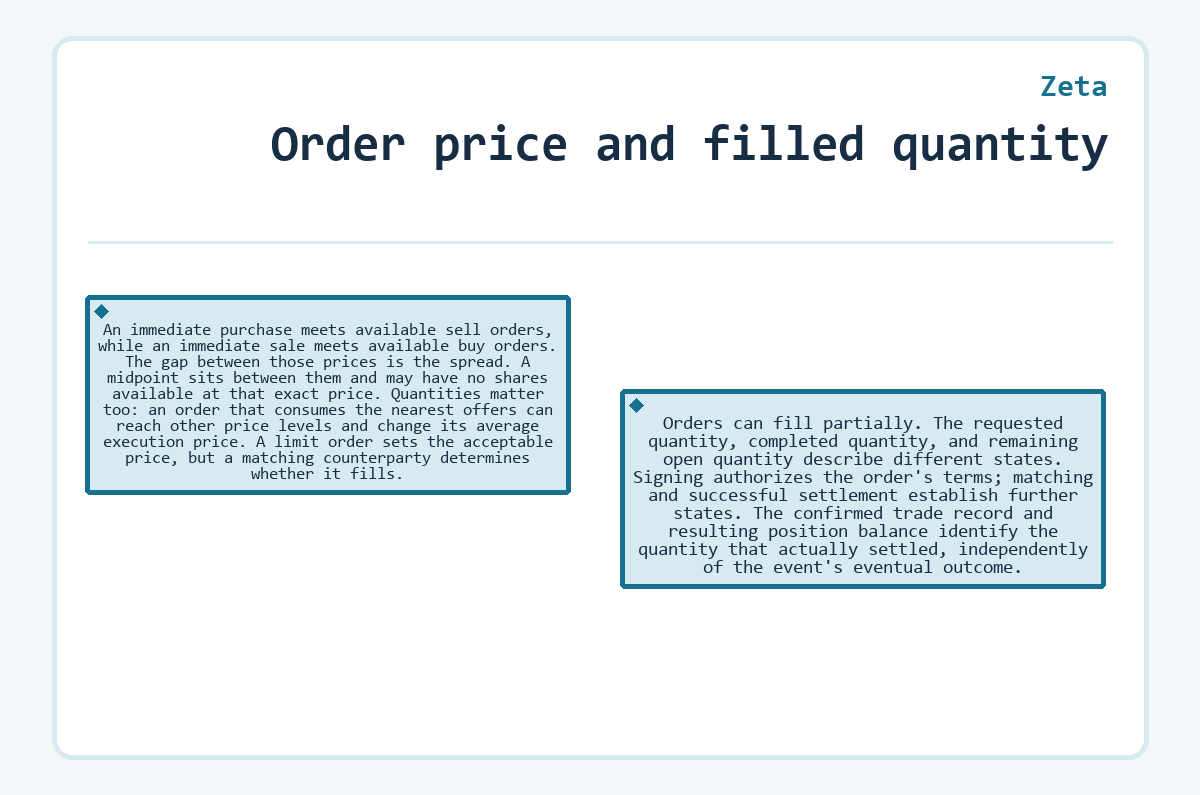
A limit order sets the acceptable price, but a matching counterparty determines whether it fills. Orders can fill partially. The requested quantity, completed quantity, and remaining open quantity describe different states. Signing authorizes the order's terms; matching and successful settlement establish further states. The confirmed trade record and resulting position balance identify the quantity that actually settled, independently of the event's eventual outcome.
What can a market price-history answer show?
A market price-history answer shows recorded prices for a selected outcome over a chosen period. Anuma supports this historical view. Polymarket's history data is associated with the outcome token, so comparing periods requires tracking the same outcome and identifying each time range. A rising Yes price and a rising No price express different changes in market expectations.
Sampling frequency affects how much detail appears in a history. Coarser sampling can leave movements between data points unrepresented. Price changes show how trading expectations changed; the curve alone does not identify their cause. A current quote adds the latest pricing context, while the history supplies the earlier path. Neither a smooth chart nor a large move establishes how the contract will finally resolve.
Resolution rules determine the event that pays
Polymarket markets have predefined rules that specify how their outcomes resolve. Those rules include the resolution source, relevant end date, and treatment of edge cases. A brief chat description can leave out a condition that changes the contract, so the market question and its detailed rules need to describe the same intended outcome.
An AI explanation does not decide settlement. For UMA-resolved markets, a proposed outcome can face a dispute before resolution becomes final. This mechanism concerns the contract's result, separately from whether an earlier purchase successfully settled. A completed purchase confirms ownership of outcome shares; the applicable resolution determines their redemption value.
Zeta: questions and answers
Do I need a Polymarket API key to ask Anuma for market data?
You do not need a Polymarket API key for Anuma's public market-data queries. The integration handles the lookup through public APIs. Authenticated order placement has separate requirements, so access to an odds answer does not provide credentials or authorization for trading.
Can I change AI models while using the Polymarket tool?
Anuma's server-side market tool works with the models offered in the app. Access to particular models depends on the account's available choices. Changing the model does not change a contract's trading eligibility, resolution rules, or payout conditions.
Which trading costs are excluded from the probability shown in chat?
A quoted probability does not include the full cost of acquiring an outcome position. The execution price and spread matter, and some Polymarket markets charge taker fees. Fee parameters vary by market category and apply when orders match. Funding intermediaries can have their own charges. A percentage alone therefore cannot establish the total acquisition cost.
Why can a searchable market be unavailable for new orders?
A market can remain identifiable even when its order book is not accepting new orders. Polymarket tracks deployment, closure, archiving, and order acceptance as distinct properties. A deployed market is not automatically ready for trading. Its live operational state determines whether the quote accompanies a market that currently accepts orders.
How do partial fills affect cancellation on the linked market?
Cancellation applies to the unfilled portion of a Polymarket order and does not reverse the quantity that already filled. Cancellation is also unavailable during configured pending delay windows for marketable orders. A partially filled order therefore leaves any acquired shares intact when its open remainder is cancelled.
Does a market's end date guarantee a payout at that time?
A market's end date can mark eligibility for resolution without guaranteeing an immediate payout. For UMA-resolved markets, an outcome proposal and any applicable challenge or dispute process determine when resolution becomes final. The date in the question identifies its event window; final resolution establishes the payout available for redemption.
What happens to pregame limit orders when a sports event starts?
Polymarket automatically clears outstanding sports-market limit orders at the game's official start time. Game start times can shift, and a game that starts earlier than scheduled can begin before that clearing occurs. The cancellation rule concerns outstanding orders; positions acquired through earlier fills remain separate.